 Fulfillment< @ >HQ Group

For ecommerce clothing brands, sourcing from China can provide access to competitive manufacturing costs, a wide range of styles, and flexible production options.
But getting clothing from a Chinese supplier to customers in Europe and the US efficiently requires more than choosing the cheapest shipping channel.
Clothing is highly competitive, seasonal, and SKU-intensive. Different sizes, colors, styles, and collections can quickly create hundreds of SKUs. At the same time, customers expect faster delivery and reliable tracking.
A smarter strategy connects:
China Sourcing → Inventory Planning → Quality Control → International Shipping → Overseas Warehousing → Local Fulfillment → Last-Mile Delivery
Here are 8 ways to optimize clothing shipping from China to Europe and the US.
There is no single best shipping method for every clothing order.
The right option depends on:
Order Volume | Product Weight | Destination | Delivery Time | Shipping Cost | Inventory Location
For smaller individual orders, direct international shipping may be practical.
For larger volumes, brands can consider bulk transportation to regional warehouses and then fulfill orders locally.
A typical strategy can be:
Small Test Orders → Direct Shipping from China
Best-Selling Products → Bulk Shipping + Overseas Warehousing
This gives brands flexibility while they test products and scale proven items.
Clothing brands often work with multiple suppliers or purchase multiple SKUs at the same time.
Shipping every product separately can increase logistics complexity and costs.
Instead, inventory can be consolidated at a China warehouse before international transportation.
The process can look like:
Multiple Suppliers → China Warehouse → Quality Check → Consolidation → International Shipping
This approach makes it easier to organize:
Different SKUs | Sizes | Colors | Purchase Orders
It can also help brands create a clearer inventory picture before products leave China.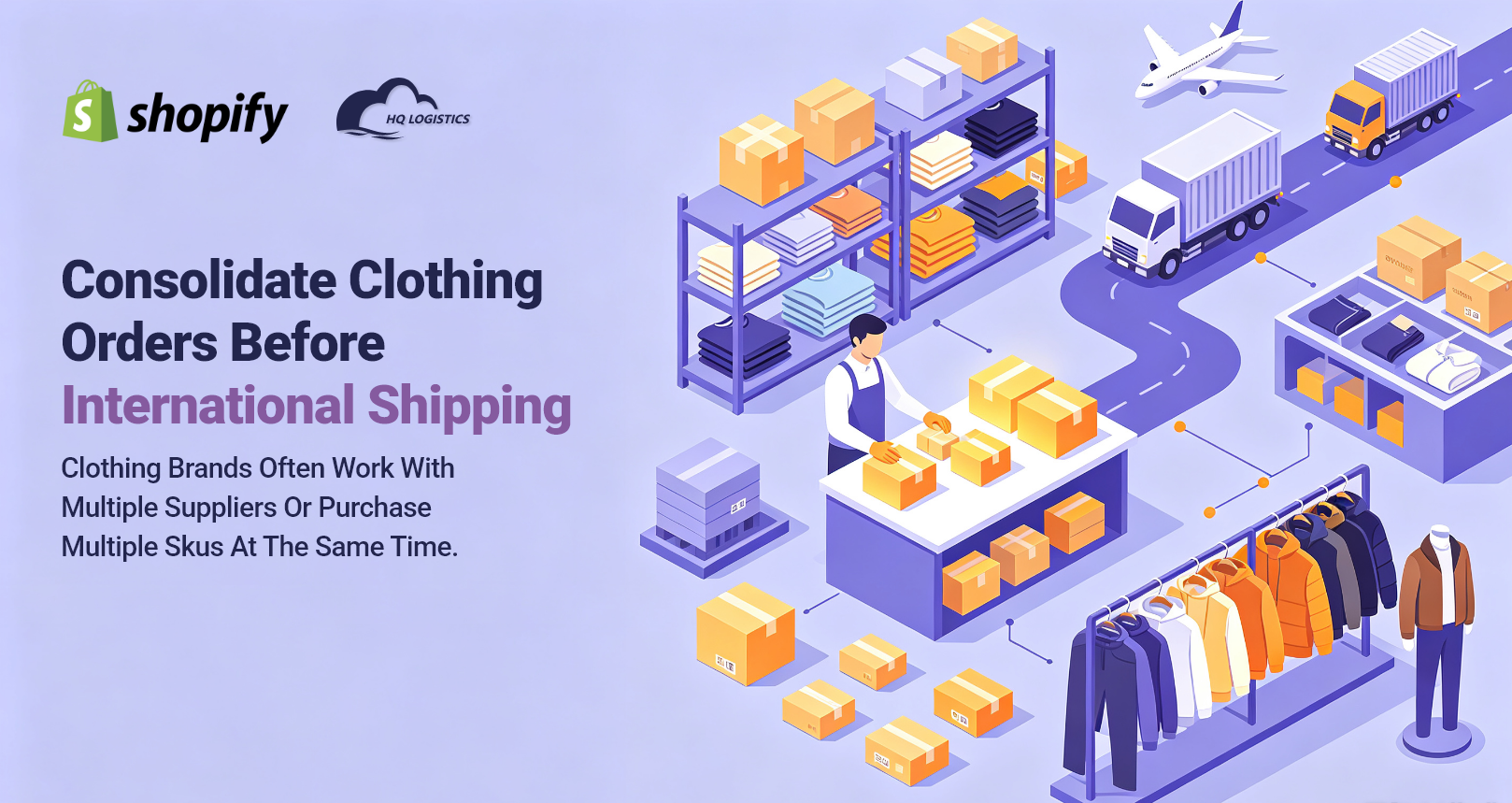
Clothing is relatively lightweight, but packaging can significantly affect shipping volume.
Oversized packaging may increase transportation costs even when the actual product is not heavy.
Brands should consider:
Foldable Packaging | Compact Poly Bags | Appropriate Carton Sizes | SKU-Based Packaging
For example, bulky packaging may make a simple jacket or sweater occupy much more shipping volume than necessary.
The goal is not simply to use less packaging.
It is to find the right balance between:
Product Protection + Package Size + Brand Experience + Shipping Cost
For premium brands, custom packaging can still be used without creating excessive package volume.
As a clothing brand grows, direct shipping from China may become less efficient for proven products.
This is where overseas warehousing becomes valuable.
Instead of:
China → Individual International Shipment → Customer
brands can use:
China → Bulk Shipment → US/EU Warehouse → Local Fulfillment → Customer
For example:
US Best Sellers → US Warehouse
European Best Sellers → EU Warehouse
This allows brands to position inventory closer to their customers before orders arrive.
It can help improve:
Delivery Speed | Order Processing | Inventory Availability | Customer Experience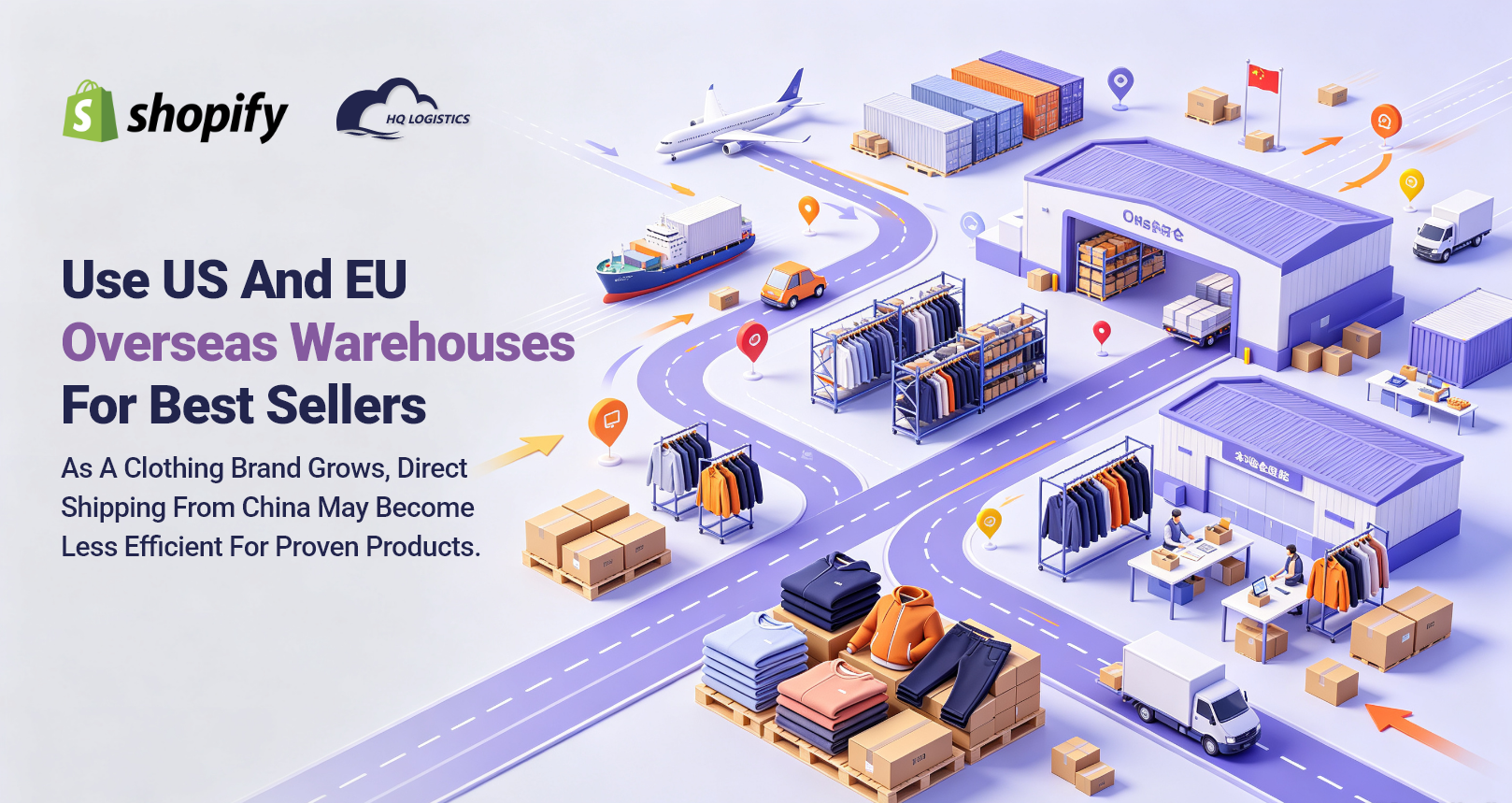
Fashion demand changes quickly.
Products can become popular because of:
Season | Weather | Social Trends | Holidays | Influencer Content | Promotions
Waiting until demand increases before ordering inventory can create a significant delay.
For seasonal clothing, brands should plan inventory ahead of time.
For example:
Summer Collection → Prepare Before Spring
Fall Collection → Prepare Before Late Summer
Winter Collection → Prepare Before Fall
For major shopping events such as Black Friday and Christmas, inventory planning should start even earlier.
A basic planning formula is:
Expected Peak Sales + Safety Stock − Existing Inventory = Required Inventory
The exact safety stock should depend on historical sales and replenishment lead times.
Clothing brands can quickly accumulate a large number of SKUs.
One product may have:
5 Colors × 5 Sizes = 25 SKUs
If a store has 50 styles, that can mean:
50 × 25 = 1,250 SKUs
Moving all of them to an overseas warehouse may tie up significant capital.
A better strategy is to categorize products.
High Demand | Stable Sales
Prioritize these for overseas inventory.
Increasing Sales | Strong Potential
Stock selectively and monitor performance.
New Styles | Uncertain Demand
Keep inventory lower and use direct shipping to test demand.
This creates a hybrid fulfillment strategy rather than forcing every product into the same logistics model.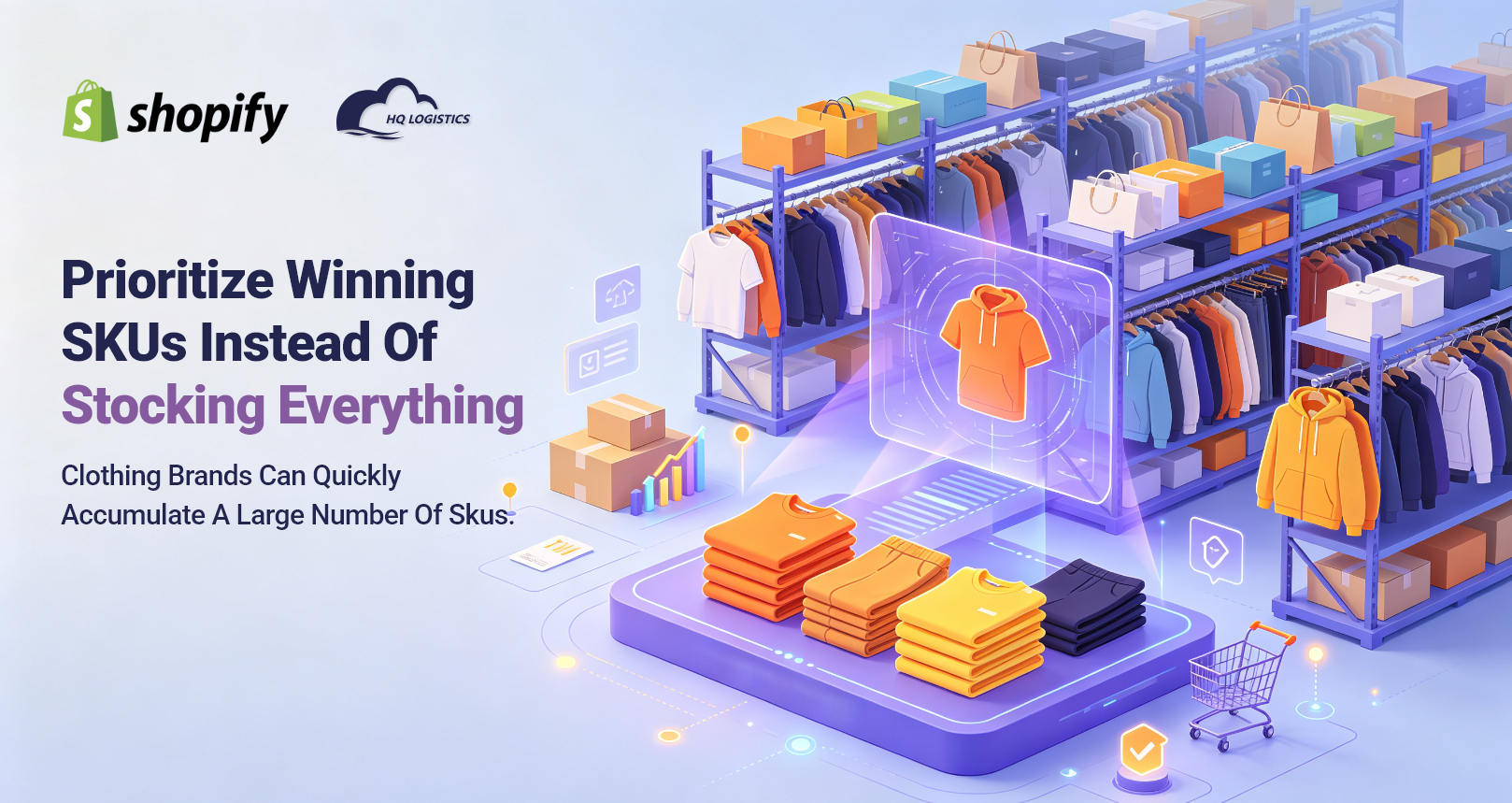
As order volume increases, manual fulfillment becomes increasingly difficult.
A connected system can automate the flow:
Shopify Order → Inventory Check → Warehouse Allocation → Pick & Pack → Shipping → Tracking
For clothing brands, this is particularly useful because of the large number of:
Sizes | Colors | Styles | Seasonal SKUs
Real-time inventory visibility can help brands know:
What Is Available | Where It Is Stored | What Is Selling Fast | When to Replenish
For brands operating both China inventory and overseas inventory, this visibility becomes even more important.
Shipping optimization should not be treated as a single logistics decision.
For growing clothing brands, multiple activities need to work together:
Sourcing
↓
Supplier Management
↓
Quality Control
↓
Inventory Planning
↓
China Warehousing
↓
International Transportation
↓
US/EU Overseas Warehousing
↓
Local Fulfillment
↓
Last-Mile Delivery
This is where a 4PL partner can provide value beyond traditional fulfillment.
Instead of simply asking:
“How do we ship this order?”
a 4PL approach asks:
“Where should this inventory be sourced, stored, and fulfilled to support the brand's growth?”
Both models have a place in a growing clothing business.
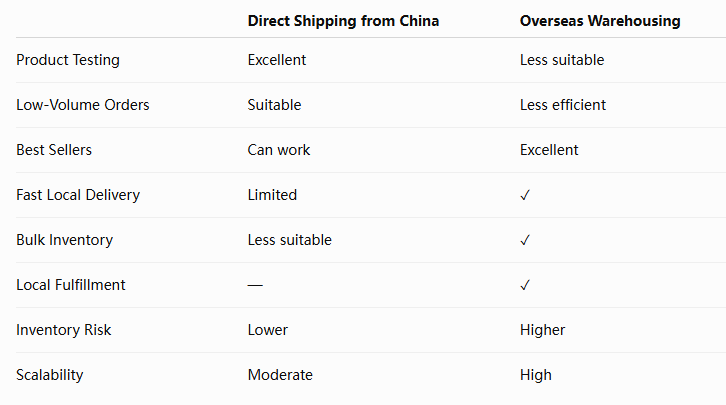
The best approach may not be choosing one model.
It may be combining both.
Use direct shipping for product testing and low-volume products, while moving proven best sellers into US or EU warehouses.
For a growing clothing brand, the ideal process can look like:
Find suitable suppliers and negotiate production and purchasing terms.
Use smaller quantities to identify products with strong demand.
Track:
Sales Velocity | Margin | Return Rate | SKU Performance
Move proven products into bulk inventory.
Allocate inventory to:
US Warehouse | EU Warehouse | China Warehouse
based on customer demand.
Use local fulfillment for faster delivery in major markets.
Monitor inventory and replenish before best sellers run out.
This creates a supply chain that grows with the brand.
Before choosing a shipping solution, consider:
Different products and destinations may have different customs and tax requirements.
Brands should ensure product descriptions, values, classifications, and required documentation are accurate.
Fashion has a relatively high return potential because customers may choose the wrong:
Size | Color | Style
A local warehouse can make returns and exchanges easier to manage in certain markets.
Before bulk transportation, inspect:
Fabric | Stitching | Size | Color | Labels | Packaging
Quality issues become much more expensive after thousands of units have already been distributed.
Avoid sending excessive quantities of trend-sensitive clothing to overseas warehouses.
Fashion inventory can lose value quickly when seasons or trends change.
There is no universal order volume that determines when a brand should move inventory overseas.
Instead, look for these signs:
Consistent US/EU Sales
Proven Best-Selling SKUs
High Repeat Order Volume
Customers Expect Faster Delivery
Direct Shipping Costs Are Increasing
Peak-Season Demand Is Approaching
You Have Reliable Sales Forecasts
When several of these conditions apply, overseas warehousing may become a more attractive option.
HQ's 4PL approach goes beyond simply storing clothing inventory.
The goal is to connect the entire supply chain:
China Sourcing → Quality Control → Inventory Planning → Bulk Shipping → US/EU Warehousing → Fulfillment → Last-Mile Delivery
For Shopify brands, this means the supply chain can be planned around actual business needs.
Instead of simply asking:
“How much does shipping cost?”
brands can evaluate:
Where should inventory be stored?
Which products should be stocked overseas?
When should inventory be replenished?
Which shipping route is most suitable?
How can delivery speed improve without unnecessarily increasing logistics costs?
This is the difference between shipping products and managing a supply chain.
For clothing brands selling from China to Europe and the US, shipping optimization is about much more than finding a cheaper carrier.
The most effective strategy combines:
Smart Sourcing | Inventory Planning | Packaging Optimization | Consolidated Shipping | Overseas Warehousing | Shopify Integration | Local Fulfillment | 4PL Supply Chain Management
The key is to match the logistics model with the product's growth stage.
Test with direct shipping.
Stock proven products overseas.
Fulfill locally when demand justifies it.
Use 4PL to connect the entire supply chain.
With the right strategy, brands can reduce unnecessary logistics complexity while building a faster and more scalable fulfillment operation for the US and European markets.
There is no single best method. For product testing and lower volumes, direct shipping from China can be suitable. For proven best sellers, bulk transportation to US or EU overseas warehouses can support faster local fulfillment.
Consider overseas warehousing when you have stable demand, proven best-selling SKUs, increasing order volume, or customers who expect faster delivery.
Costs depend on product weight, package dimensions, shipping method, destination, order volume, and customs requirements. Packaging optimization and bulk transportation can help improve overall logistics economics.
No. Prioritize best-selling and stable-demand products. New styles and uncertain products can remain in a lower-risk direct-shipping model until demand is proven.
A 4PL partner can coordinate sourcing, quality control, inventory planning, international transportation, overseas warehousing, fulfillment, and replenishment, giving brands a more integrated supply chain strategy.
Yes. A hybrid model is often useful for clothing brands. New products can be tested through dropshipping, while proven products are moved into regional warehouses for faster fulfillment.
📩 Email: zoye@fulfillment-cn.com
Previous Recommendations


clothing shipping from China to Europe and the US | clothing shipping from China | clothing fulfillment | clothing logistics | apparel fulfillment | US clothing warehouse | EU clothing warehouse | overseas warehousing | clothing dropshipping | Shopify clothing fulfillment | 4PL fulfillment | how to ship clothing from China to the US | how to ship clothing from China to Europe | best shipping method for clothing from China | clothing fulfillment for Shopify brands | US warehouse for clothing brands | EU warehouse for clothing brands | clothing inventory planning | clothing supply chain management | apparel fulfillment service | 4PL for clothing brands




Don't wait until next year, grab the chance on 2025. Here are some recommended ecommerce topic you can choose.
Thanks to the support and trust from our customers. Flashback with our beloved partners.